

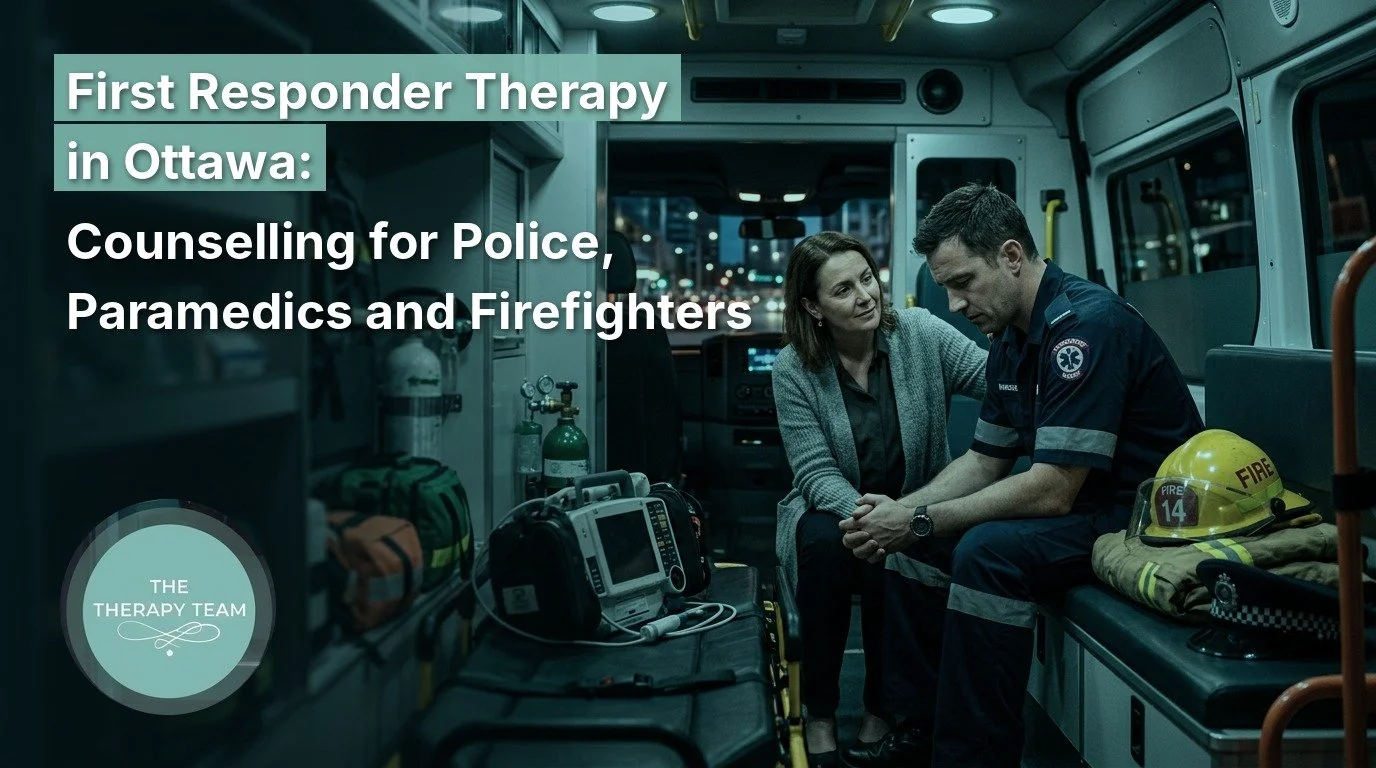
You are the person other people call. That is most of the problem.
First responders wait longer than almost any other professional group before getting help, and the reasons are specific rather than vague. This page is about those reasons, what treatment actually involves, and how the Ontario system works if you are considering therapy.
We see first responders across Ontario by secure video, including clients in Ottawa. We are not able to see clients located in Quebec, including the communities on the Quebec side of the Ottawa border.
Why the job is different
Ordinary work stress accumulates. This does not accumulate so much as deposit.
A first responder often talks about the calls that had a child in them, or a face they recognized, or the one where everything was done correctly and it made no difference. Those sit separately from the rest, and they do not fade in the way the job expects them to.
There is also a second category that gets missed entirely, because it is not fear based. It is what happens when you are made to act against what you believe is right, or you watch it happen and cannot stop it. The patient you could not reach because of a protocol. The call you were pulled from. The decision made above you that you carried out. That is moral injury, and it produces guilt and anger rather than the alarm and flashbacks people expect from trauma. It is routinely mistaken for burnout and treated as though rest will fix it. Rest does not fix it.
What tends to show up, and in what order
Sleep usually goes first. Not nightmares necessarily, just shallow sleep and waking at the same hour.
Then irritability, which lands on the people at home rather than at work, because at work it is managed. Then substances, for example, drinking that starts as a way to come down after nights and becomes the only way to come down. Then the narrowing, where the things you used to do outside the job quietly stop happening.
Emotional numbness often arrives last and is frequently mistaken for coping. You are calm at scenes that should move you and you are also flat at your own kitchen table. That is the same mechanism, and it does not switch off because you took the uniform off.
Police, paramedics, fire and dispatch
These are treated as one category and they are not.
Paramedics
The most sustained exposure of any of them, often with the least recovery time between calls. Paramedics also carry an unusual kind of helplessness, because they are frequently present for the worst moment without the means to change it.
Police
Trauma plus hypervigilance that cannot be switched off, plus a public scrutiny element the others do not carry in the same way. Many officers describe not being able to sit with their back to a room year after they stopped noticing they did it.
Firefighters
Long waits broken by extreme events, many medical calls and rescues which is its own difficulty, plus a strong crew culture. That culture is protective and it is also the thing that makes individual help feel like you’re incompetent.
Dispatchers
The most overlooked group in the entire sector. Dispatchers take the call, hear the worst of it in real time, and almost never find out how it ended. There is no resolution to attach the experience to, which is a specific and well documented difficulty.
We have worked with Toronto Police, Peel Regional Police and paramedic services. We have no formal association with any of them, and this page does not suggest one.
What Ontario law says, and the part people get wrong
This matters if you are considering a WSIB claim, and it is worth understanding before you start rather than after.
The Supporting Ontario's First Responders Act, passed in 2016, amended the Workplace Safety and Insurance Act so that post-traumatic stress disorder diagnosed in a covered first responder is presumed to be work related. The employer has to show otherwise, rather than you having to prove the connection.
Covered occupations include firefighters, including volunteers, and fire investigators, police officers, emergency response team members, paramedics and emergency medical attendants, ambulance service managers, dispatchers, and workers in correctional institutions and places of secure custody or detention.
The part that catches people out
The presumption applies to PTSD that has been diagnosed. For the WSIB presumption, that diagnosis must come from a psychiatrist or a psychologist.
A Registered Social Worker or Registered Psychotherapist can treat you, and treat you well, but cannot provide the diagnosis that triggers the presumption. We are not able to make it.
So if a claim is part of your plan, you need both: a psychiatrist or psychologist for the diagnosis, and a therapist for the ongoing work. They are different appointments and it is worth lining them up deliberately rather than discovering the gap halfway through.
If a claim is not part of your plan, none of this applies and you do not need a diagnosis to start therapy.
One further detail worth knowing. The Act does not cover psychological injury arising from your employer's employment decisions, such as discipline, a change of duties, or termination. Those are real and they are painful, and they sit outside this particular presumption.
This is general information and not legal advice. For your own claim, speak with your union representative or a lawyer who handles WSIB matters.
Confidentiality, and what your employer is not told
This is the question that stops more first responders from booking than any other, so here is the direct answer.
What you say in session stays in the room, with a narrow set of legal exceptions that apply to every regulated therapist in Ontario: a serious risk of harm to you or someone else, a child currently at risk, abuse by another regulated health professional, and a court order. That is the list.
Your service is not notified that you attended. Your file is not shared with your employer. Nothing goes to your doctor unless you give written consent.
Fitness for duty is a separate process requested by an employer. It is not what a therapy session is, and if you are ever asked to attend one it should be clearly identified as such.
Shift work is the real barrier
More first responders drop out of therapy over scheduling than over anything clinical.
A standing Tuesday at two in the afternoon does not survive contact with a rotating roster. Virtual sessions solve more of this than people expect, because they remove the drive, and because a session can happen from home before a night shift rather than requiring a whole afternoon to be carved out.
Tell us your rotation at the start. It is a practical problem with practical solutions and it should not be the reason that you cannot seek therapy.
What treatment usually involves
Not reliving every call. That needs saying because it is the assumption most people arrive with.
Early work is usually about regulating a nervous system that has been running hot for years, because nothing else is workable until that settles. Trauma processing comes after, and it is targeted at the specific events that are still live rather than your whole career. Where moral injury is present, that is different work again and it looks more like grief and moral repair than fear.
Approaches used include EMDR, which has the largest evidence base for PTSD, and body based work for people who find talking about it activating. What is the best modality to use will be assessed and customized for you?
Common questions
-
Yes, with the four narrow legal exceptions listed above. Your employer is not told that you attended or what was discussed.
-
Attending therapy is not reportable by your therapist. Fitness for duty assessments are a separate employer initiated process. If you have a specific concern about your role, raise it in the first session and get a clear answer before going further.
-
No. You simply need to want to work on some symptoms that are hindering your quality of life.
-
No. For the presumption under Ontario law the diagnosis must come from a psychiatrist or psychologist. We can treat you and work alongside that process.
-
Yes. We offer secure video sessions to clients in Ottawa. We are not able to see clients located in Quebec, including the communities on the Quebec side of the border.
-
This does not expire with the job. A great deal of what people carry only surfaces once the structure of the work is gone.
Book a free fifteen-minute call
No intake form first, no commitment to continue, and we will work around your rotation.
Sources
Supporting Ontario's First Responders Act, 2016 (Bill 163), amending the Workplace Safety and Insurance Act, 1997
Covered occupations and the diagnosis requirement: WSIB Ontario